

close
Choose Your Site
Global
Social Media


Views: 0 Author: Site Editor Publish Time: 2026-11-22 Origin: Site


Selecting the correct trunking size is a critical compliance and safety decision. It represents far more than just an aesthetic choice. You must protect wires from physical damage while meeting strict building codes. Undersized trunking leads directly to dangerous thermal buildup. Installers often scrape or tear cables when forcing them into tight channels. This inevitably triggers costly code violations during inspections. Conversely, oversized enclosures waste your project budget and consume valuable wall footprint. You need a reliable, exact method to specify required dimensions. This guide provides a mathematical, compliance-based framework for calculating exact trunking dimensions. We built this framework for your specific wiring project needs. You will learn to evaluate cable loads accurately and safely. We will help you apply industry standards to prevent overheating. Following these steps ensures long-term infrastructure reliability.
The 45% Rule: Never fill trunking to 100% capacity; industry standards dictate a maximum 45% fill ratio to allow for heat dissipation and future cable pulls.
Cable Separation: Power and data cables require physical separation, often necessitating wider, compartmentalized trunking.
Bend Radius Matters: Trunking depth must accommodate the minimum bend radius of your thickest cable, particularly for fiber optics or heavy-duty power lines.
Environment Dictates Profile: The choice between standard wall-mounted profiles and specialized skirting depends on the facility's traffic and structural constraints.
Poorly sized cable management systems introduce severe, hidden risks. They threaten both operational stability and building safety. You must address these hazards proactively during the design phase.
Overcrowded cables cannot dissipate heat effectively into the surrounding air. Electrical currents naturally generate thermal energy during normal operation. When packed tightly, cables trap this continuous heat. This localized warming process degrades the protective polymer insulation over time. Brittle insulation eventually cracks and exposes bare copper conductors. This dramatically increases the risk of an electrical arc fault and subsequent fire. Proper sizing guarantees adequate airflow around every single jacket.
Electrical codes heavily regulate conduit and trunking fill capacities globally. The National Electrical Code (NEC) and British Standard 7671 establish strict spatial limits. Inspectors actively check these ratios before signing off on projects. Failing a routine inspection results in mandatory, costly rework. You might have to rip out and replace entire infrastructure runs. Doing the math upfront prevents these expensive legal and regulatory headaches.
Tight enclosures make routine facility maintenance incredibly difficult. Troubleshooting a faulty power line becomes a labor-intensive nightmare. Adding new network drops causes major office disruptions. You risk damaging existing fragile fiber lines when forcing new wires through. A well-sized system lets technicians glide new lines through effortlessly. This minimizes downtime and drastically reduces ongoing IT maintenance disruptions.
You cannot simply eyeball a plastic channel to see if wires fit. You must use precise geometric calculations. Quality Electrical PVC Trunking requires strict adherence to international fill ratio standards.
The fill ratio is the exact percentage of the trunking's internal cross-sectional area occupied by cables. It tells you how much free space remains for passive airflow. You must measure this inside the main compartment, ignoring external dimensions.
Industry benchmarks dictate a maximum fill ratio of 45 percent. You might wonder why we leave 55 percent empty. This limit ensures critical safety margins. It provides essential air gaps for radiant heat dissipation. It also leaves enough physical maneuvering space to pull wires safely. Exceeding 45 percent practically guarantees installation damage and future thermal issues.
Use the overall diameter (OD) of your specific cables. Do not guess or use generic estimates. Calculate their true cross-sectional area using the standard geometric formula A = πr². Find the radius by dividing the measured OD by two. Square this radius, then multiply it by pi (3.14159). This yields the exact millimeter footprint of each individual wire. You add these together to find your bundle size.
Different wire types stack and behave differently inside the enclosure. Solid core wires hold their shape rigidly and resist bending. Stranded networking wires flex easily and nest together more closely. However, you must calculate both types using their maximum outer diameter. This mathematical rigor guarantees you never exceed the safe physical limits of the PVC Cable Trunking.
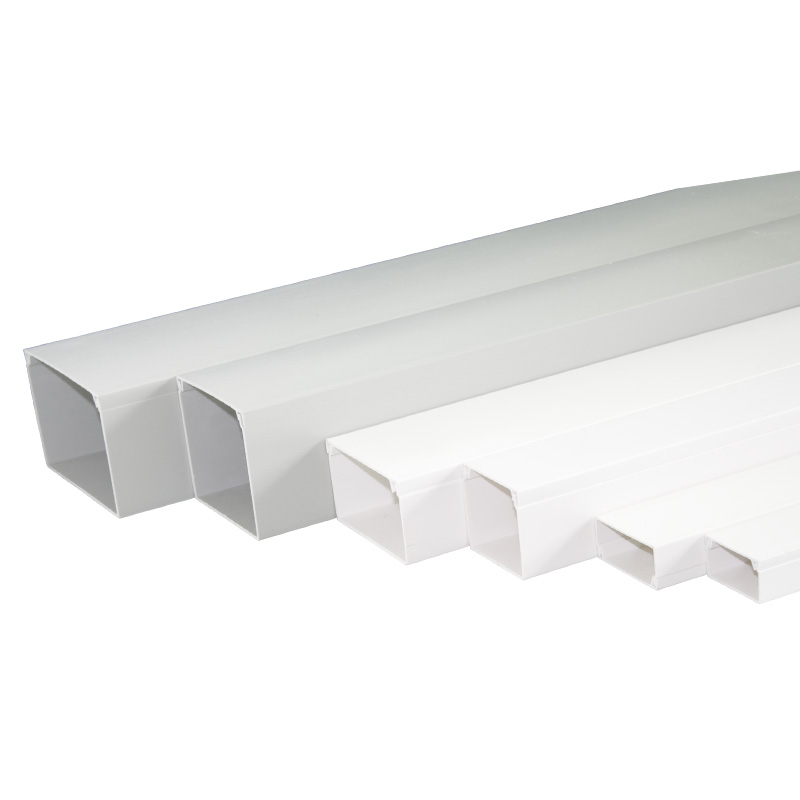
Follow this proven mathematical process to size your installation correctly. It prevents hazardous guesswork and ensures strict building code compliance.
Step 1: Audit the Cable Load. List the exact quantity of every cable going into the planned run. Record the manufacturer-specified outer diameter (OD) for each specific type.
Step 2: Calculate Total Cable Area. Apply the area formula to each individual cable size. Multiply the single cable area by the total quantity of that type. Sum all these cross-sectional areas to find your total bundle footprint.
Step 3: Apply the Fill Factor. Divide your total calculated cable area by 0.45. This division calculation reveals the absolute minimum required internal area of the trunking.
Step 4: Determine Minimum Depth. Identify the single cable boasting the largest minimum bend radius. This specific measurement establishes the absolute minimum depth of your enclosure.
Step 5: Add a Future-Proofing Buffer. Factor in an additional 20% allowance for future facility expansion. Network upgrades frequently require thicker, heavily shielded cables. Plan for this inevitable growth right now.
Cable Type | Outer Diameter (mm) | Single Area (mm²) | Quantity | Total Area (mm²) |
|---|---|---|---|---|
Cat6a Ethernet | 7.5 | 44.18 | 12 | 530.16 |
12 AWG Power | 4.0 | 12.57 | 6 | 75.42 |
Fiber Optic | 3.0 | 7.07 | 4 | 28.28 |
Total Bundle | - | - | 22 | 633.86 |
In this scenario, dividing 633.86 by 0.45 means you need an internal trunking area of at least 1408.57 mm².
Selecting the right profile shape matters just as much as internal volume. Different architectural environments demand entirely different physical shapes.
These robust rectangular profiles handle heavy-duty commercial applications perfectly.
Best for: Server rooms, industrial manufacturing facilities, and vertical utility drops. They excel in utilitarian spaces prioritizing function over aesthetics.
Sizing considerations: Manufacturers offer these in high-capacity, deep profiles. A common industrial size is 100mm x 50mm. You use these for heavy electrical loads requiring maximum internal volume. Wall Mounted PVC Trunking offers straightforward, unobstructed internal capacity for massive bundles.
These specialized profiles replace traditional baseboards or run horizontally at desk height.
Best for: Office environments, hospitals, and commercial spaces. They provide necessary aesthetic integration while hiding complex wiring.
Sizing considerations: Skirting profiles are often much shallower than industrial variants. They require compartmentalized sizes. You must run power and data side-by-side without causing electromagnetic interference. Each compartment must independently pass the 45% fill ratio test.
Sometimes baseboard profiles simply lack the necessary internal volume. When cable volume exceeds physical limits, you must evaluate alternative routing. Look into ceiling drops, cable trays, or raised floor boxes. Do not force an undersized skirting profile to hold industrial-level loads. It will fail inspections and damage your network lines.
Profile Type | Primary Environment | Depth Characteristic | Compartmentalization |
|---|---|---|---|
Standard Wall Mounted | Industrial, Server Rooms | Deep (up to 100mm+) | Usually single large channel |
Dado Trunking | Offices, Laboratories | Medium (Desk height) | Multi-compartment standard |
Skirting Trunking | Commercial, Residential | Shallow (Baseboard) | Multi-compartment standard |
Micro Trunking | Home, Single Wire Runs | Very Shallow (12mm) | Single channel only |
Even experienced installers occasionally miscalculate trunking dimensions. Avoid these frequent pitfalls to guarantee a smooth, compliant installation.
Ignoring Internal Dividers: Many installers forget about internal plastic partitions. We use these dividers to separate high voltage from low voltage. They consume valuable internal volume. This significantly reduces your overall available capacity. You must subtract the divider thickness from your total area calculations.
Overlooking Corner Fittings: Do not calculate your capacity based solely on straight runs. Internal and external corner accessories often have slightly less internal clearance. Cables naturally bunch up and overlap at these 90-degree bends. If you size the straight run exactly at 45%, the corners will inevitably exceed safety limits.
Mixing Cable Types Blindly: Never place heavy, rigid power cables directly on top of fragile data cables. Deep trunking exacerbates this specific issue. Gravity pulls the heavy weight down, causing physical crushing. It also leads to severe signal degradation and crosstalk in networking lines. Always use compartments or stack lighter cables on top.
Proper sizing relies heavily on exact cross-sectional math. You must adhere strictly to the 45% fill rule for safety. Always plan for future expansion by adding a 20% capacity buffer. Guesswork inevitably leads to thermal hazards, crushed wires, and failed electrical inspections.
Before finalizing any purchase order, take one final verification step. Consult the manufacturer's specific conduit sizing chart. Match your calculated internal area requirements directly with available commercial SKUs. This simple verification step prevents costly returns and ensures a safe, compliant wiring infrastructure.
A: Yes, common sizes range from micro (12x12mm) to heavy-duty industrial (100x100mm or larger). However, exact internal dimensions vary by manufacturer. Always check the specific product data sheet to confirm the true internal cross-sectional area before calculating your fill ratio.
A: Depth is dictated by the minimum bend radius of your thickest cable and whether you need to cross cables over one another inside the channel. Fiber optic cables, for instance, require significantly deeper channels to prevent micro-bending and signal loss.
A: While low-voltage cables don't pose the same thermal risks as power cables, overpacking them causes physical strain, violates PoE (Power over Ethernet) heat dissipation guidelines, and makes future upgrades nearly impossible. You should still adhere to the 45% fill ratio.
A: Yes. Residential applications typically require smaller, single-compartment profiles (like 25x16mm), while offices usually require multi-compartment dado trunking to handle parallel power and data routing safely without signal interference.


